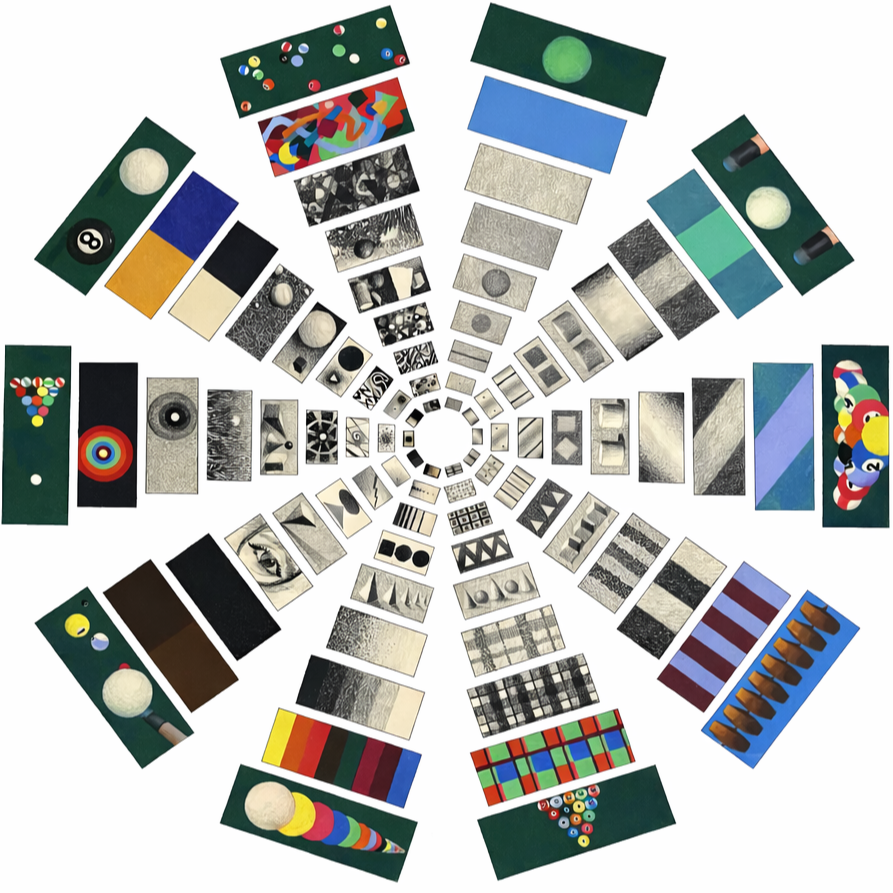
The Syntax of Visual Language
A practical framework for how visual art works.
Visual art is built from parts, much like spoken language. Those parts interact to create meaning, clarity, and impact.
The Syntax of Visual Language teaches you to see what’s happening and make deliberate choices in your work.
Over time, artists either refine clarity or break structure entirely. Both paths are valid when they’re chosen with intention.
This system was discovered by Walter Lee Schofield in 1971 and has guided his work ever since.
It’s not about style. It’s about communication.
The Elements
The raw materials of visual art. In this diagram, they form the rings of the wheel:
NEGATIVE SPACE – The empty space surrounding visual elements. The nothing surrounding the something.
POSITIVE SPACE – The form itself. The mass that occupies space. The something among the nothing.
POINT – dot, speck, point, etc… One or several points can guide the eye to tell a story.
LINE – A connection between points which may provide direction, movement, and structure.
SHAPE – Flat 2D forms: circle, square, and triangle.
FORM – 3D shapes with depth and volume: sphere, cube, pyramid, cone, & cylinder.
TEXTURE – Surface quality such as rough, smooth, soft, sharp, & slick.
VALUE – Light and dark. Contrast and depth through the spectrum of tones.
COLOR – The aesthetic hue and energy.
THEME – The underlying idea. What the work is about overall.
The Expressions
How the elements interact to create meaning. In this diagram, they form the spokes of the wheel:
UNITY – Everything belongs. The elements feel connected and cohesive.
BALANCE SYMMETRICAL – Even distribution through mirroring.
BALANCE ASYMMETRICAL– Uneven elements that still feel balanced.
REPETITION – A single element repeated.
PATTERN – Repetition organized into a system.
TRANSITION – A gradual shifting which guides the eye from one state to another.
TENSION – Provocative visual pressure. Something feels unresolved or unstable.
EMPHASIS – Where the eye lands. The focal point.
CONTRAST – Complementary opposition. Light/Dark, Rough/smooth, Big/Small, etc...
VARIETY – Intentional chaos to avoid monotony.